Why Traditional Hangars No Longer Match Modern Aviation
In conventional aviation thinking, a hangar means months of permitting, heavy concrete foundations, and a fixed location that can never move. As global operations, military deployments, and emergency response missions grow more complex, portability and ultra-fast response have become the new competitive edge in aviation infrastructure.
Chongqi — currently China’s only dedicated manufacturer of professional inflatable portable aircraft hangars — converts the rigid, capital-intensive hangar into an intelligent, mission-ready asset that can be deployed in hours rather than months.
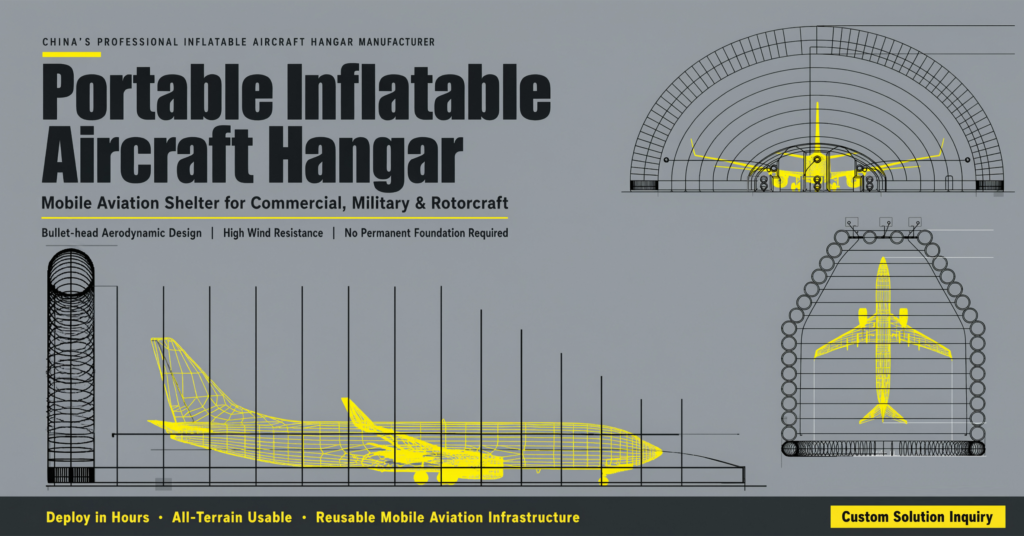
Speed Revolution: From Months to Hours
A traditional steel hangar can take 6–24 months from planning to operational readiness. A Chongqi portable aircraft hangar changes that equation completely.
24–48 hTypical full deployment
6–10Technicians required
ISO 20′Container-compatible packing
0Permanent foundations needed
- Plug-and-play inflation — high-capacity blowers erect a structure large enough for a Boeing 737 or Airbus A320 in days, often within tens of hours.
- Ultra-compact logistics — when deflated, the entire system packs onto standard pallets or into a 20-foot ISO container and can be airlifted by C-130 or moved by ordinary trucks.
- All-terrain readiness — operates on concrete, compacted soil, or sand without permanent foundations, making it ideal for forward bases and temporary airports.
Bullet Head Aerodynamics: Built for Storms
Chongqi pioneered the Bullet Head aerodynamic profile in the portable aircraft hangar category. Inspired by high-speed rail and modern aircraft noses, the streamlined shape is an engineering solution, not a design flourish.
Proven performance: CFD simulations confirm 20–30 % lower air resistance and 20–40 % higher structural stability versus conventional arched designs. Combined with ground anchors and multi-ton ballast, the structure is rated for 100–120 km/h (Force 11–12) winds — critical for typhoon-prone regions.
- Smooth airflow reduces stress on membranes and anchoring points
- Multi-chamber independent air beams with failure isolation
- High-strength PVC-coated fabric (900–1300 g/m²) or optional military-grade high-modulus polyethylene
- 10–20 year service life under normal conditions
Intelligent Heart: NP06s Precision Pressure Control
A Chongqi portable aircraft hangar is far more than a large tent. At its core is a military-grade automatic pressure management system.
- 0.06 PSI precision — far tighter tolerance than conventional imported relief valves
- 24/7 smartphone monitoring — operators track real-time pressure via dedicated app; smart pumps auto-compensate for temperature swings from –35 °C to +50 °C+
- True redundancy — each air beam is an independent sealed chamber connected by 3-ton-rated nylon webbing. If one chamber is compromised, the remaining structure stays fully operational
The result is continuous structural integrity and uninterrupted protection for high-value aviation assets.
Strategic Investment: Clear Return on Value
For airlines, MRO providers, and military commanders, a portable aircraft hangar is a high-ROI asset-protection tool rather than a sunk cost.
| Metric | Chongqi Portable Aircraft Hangar | Traditional Steel Hangar |
|---|---|---|
| Typical CAPEX (60 × 60 m) | USD 400 000 – 600 000 | ~3–4× higher |
| Initial cost reduction | ≈ 70 % lower | Baseline |
| Deployment time | Hours to 2 days | Months to years |
| Residual value (3-year estimate) | 55–65 % | Near zero + demolition cost |
| Energy performance | Up to 90 % natural light transmission; white exterior reflects heat | Full artificial lighting & higher HVAC load |
| Service life | 10–20 years with proper care | 30+ years but immobile |
High residual value and repeated redeployability turn the hangar into a movable asset that retains worth across multiple missions.
Aircraft-Specific Sizing & Global Applications
Every portable aircraft hangar is engineered to the exact mission profile:
- Narrow-body / regional jets — Boeing 737 series: recommended 55.5 m × 54 m; Airbus A320/A321: 52 m × 54 m
- Wide-body — Airbus A330: 91 m × 91 m; Boeing 747 / A380-class: custom up to 100 m × 96 m
- Rotorcraft & UAVs — 5–12 m clear height with pillar-free spans optimized for blade clearance and maintenance access
Modules can be linked in series or parallel to create multi-bay facilities. Door options include full-width clamshell, side-sliding, and high-speed roller doors with optional nose cut-outs for helicopter operations.
Flight Is Boundless — Ground Support Should Be Too
Chongqi portable aircraft hangars are more than shelters. They embody the “follow-the-mission” philosophy: aerodynamic efficiency fused with intelligent pressure control so that aviation support is no longer limited by geography.
Flight has no borders. With Chongqi, neither does protection.
Ready for Your Custom Portable Aircraft Hangar Solution?
Request a tailored configuration, ROI projection, and deployment plan for your airport or forward base.
Visit www.inflatable-hangar.com
Email: [email protected]