Market Growth, Technology Breakthroughs, Competitive Landscape & Decision Framework for Aviation Operators
Strategic Context (2026)
The global inflatable maintenance hangar market is projected to reach approximately $2.1 billion in 2026 and grow at a compound annual growth rate (CAGR) of 6.3% to reach $3.02 billion by 2032. Inflatable hangars have moved from niche temporary shelters to mainstream smart assets used by commercial operators, defense forces, and emerging eVTOL/UAV ecosystems.

1. Market Reality: From Temporary Shelter to Intelligent Asset
Key Market Drivers
- Increasing maintenance pressure at regional airports
- Defense rearmament and rapid-deploy requirements
- Explosive growth of UAV and eVTOL operations
- Demand for climate-resilient infrastructure in extreme weather zones
Technical Definition
Modern inflatable hangars rely on a positive-pressure shell (typically maintained at 1.5–2.0 psi) that functions as the primary load-bearing structure. This controlled over-pressure enables the membrane to resist wind and snow loads while remaining lightweight and rapidly deployable.
Economic Advantages vs Traditional Steel Hangars
- Deployment speed: 5–7 days versus 3–6 months (≈99% faster)
- Capital cost reduction: 70–80%
- Comparable service life: 15–25 years
- High residual value and full redeployability
2. Key Trends, Disruptive Innovations & Risks
Key Trends
- Intelligent Integration — Hangars are evolving into smart buildings with automatic climate control and real-time pressure monitoring via mobile apps.
- Modularity & Scalability — Structures can be sized and extended to accommodate A320, B737, and even customized wide-body aircraft.
Disruptive Innovations
- Bullet-Head Aerodynamic Design — Chongqi’s pioneering streamlined “Bullet Head” shape reduces air resistance by 20–30% and raises wind resistance to 100–120 km/h.
- Millibar-Level Precision Control — Systems such as NP06s achieve 0.06 PSI accuracy, significantly outperforming traditional imported relief valves.
Potential Threats
- Extreme climate events (e.g., super typhoons) may still require temporary deflation as a precaution.
- Varying regional regulations for temporary structures can affect permitting timelines.
3. Competitor Benchmarking (Top 5)
| Competitor | Business Model | Core Strength | Brand Positioning | Pricing Strategy |
|---|---|---|---|---|
| Buildair (Spain) | Full lifecycle management | European standards & large-structure engineering | Premium / industry benchmark | High premium |
| Aviatema (US/Global) | Boeing global distribution partner | Strong network & brand endorsement | Military-civilian dual use / reliability | Mainstream market |
| JB Roche (Ireland) | 20+ years aviation shelter focus | FAA approval, IglooMX® patented technology | Trusted partner | Premium pricing |
| LANCO (North America) | Rapid-response force supplier | Engineering optimized for harsh climates | Extreme-environment specialist | Mid-to-high end |
| Chongqi’s (China) | R&D-driven manufacturing expert | Only Chinese supplier with Bullet-Head design & high cost-performance | Value + resilience innovation | Highly competitive |
4. Strategic Assessment: SWOT, Porter’s Five Forces & Value Chain
SWOT Analysis
- Strengths — Hour-level rapid deployment, low CAPEX, no foundation required, residual value of 55–65%.
- Weaknesses — Long-term operation depends on continuous power; membrane is sensitive to sharp objects.
- Opportunities — Fast-growing Asia-Pacific aviation sector, eVTOL market expansion, temporary cover during traditional hangar renovations.
- Threats — Strict international compliance requirements (EN 1991, Eurocodes).
Porter’s Five Forces (Summary)
- Rivalry among existing competitors: Medium-to-high (intelligence and material patents create barriers).
- Supplier power: Medium (high-strength PVC/PVDF membranes and intelligent algorithms are key).
- Buyer power: High (B2B/B2G customers are highly sensitive to compliance, total cost of ownership, and wind-resistance data).
- Threat of substitutes: Low (traditional steel is far more expensive; conventional temporary tents lack sufficient wind resistance).
Value Chain Focus Areas
- R&D — CFD aerodynamic modeling and new material testing.
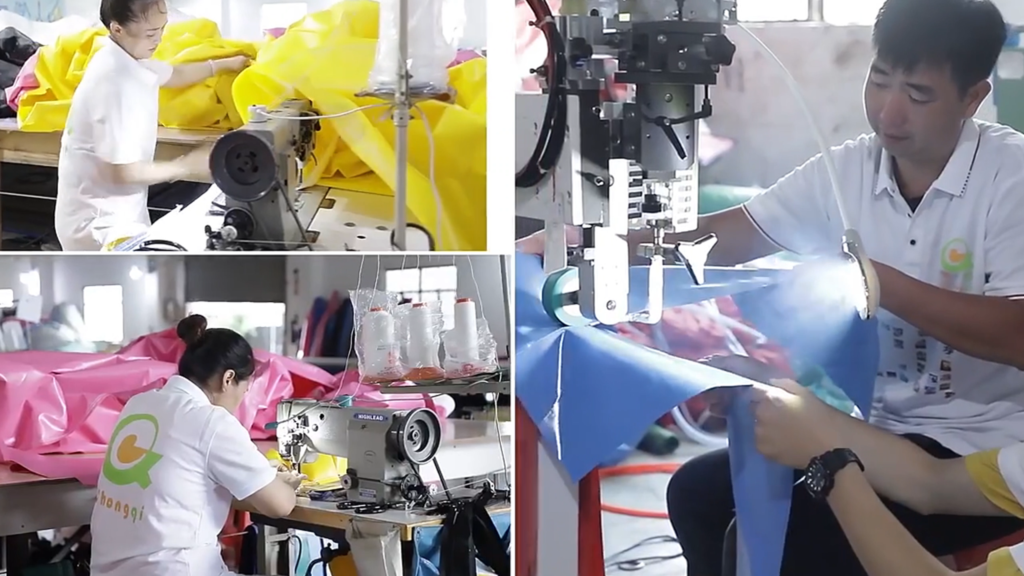
- Manufacturing — Closed air-column hot-air welding process; CE/RoHS certification essential.
- Marketing — Quantified ROI, reduced AOG recovery time, and on-site training services.
Frequently Asked Questions
How large is the global inflatable aircraft hangar market in 2026?
The market is projected at approximately $2.1 billion in 2026, growing at a 6.3% CAGR to reach $3.02 billion by 2032.
What are the main advantages of inflatable hangars over traditional steel structures?
Deployment is typically 5–7 days versus 3–6 months, capital costs are 70–80% lower, and the structures offer comparable 15–25 year service life with high residual value and full mobility.
What is the Bullet-Head design and why does it matter?
It is an aerodynamic streamlined shape that reduces air resistance by 20–30% and enables wind resistance of 100–120 km/h, significantly improving performance in typhoon-prone regions.
How precise is modern intelligent pressure control?
Advanced systems such as NP06s achieve 0.06 PSI accuracy — far tighter than traditional imported relief valves — ensuring structural stability under temperature changes.
Who are the main global competitors in this market?
Key players include Buildair (Spain), Aviatema (US/Global), JB Roche (Ireland), LANCO (North America), and Chongqi’s (China), each differentiated by technology, distribution, and pricing strategy.
What are the primary risks operators should consider?
Extreme weather events may still require temporary deflation, continuous power is needed for long-term pressure maintenance, and local permitting rules for temporary structures can vary.
Need a customized technical evaluation for your aircraft type and location?
Contact the Chongqi’s engineering team for project-specific sizing, wind-load analysis, and total cost of ownership modeling.
Guangzhou Chongqi Industrial Co., Ltd.
Custom Inflatable Aircraft Hangar Your Trusted Buildings Solution
Contact

WhatsApp/Tel: 008615622252504
Email: [email protected], [email protected]
Location

Chongqi Inflatables Factory, No.69, Zhuliao Avenue East, Zhongluotan Town, Baiyun District, Guangzhou, China.